 gamelogix5.com
Who Gets to Look? The Cameras of Grand Theft Auto VI

An alligator walks into a convenience store. The camera stays put. That second detail makes the first one funny. A person filming would have a decision to make about something with that many teeth coming through the door. The store camera has a patch of floor to cover. For a second in the first Grand Theft Auto VI trailer, we have to share its peculiar professional interest in the entrance. A few cuts later, a news camera will have an entirely different professional interest in an overturned car. By the end, two people in a dim room will look at each other in a way that neither camera could explain. Follow those changes of viewpoint through the first two trailers and Vice City starts to look like a place with a serious disagreement about what pictures are for. Some people need a record, some need a laugh, and two of them need an answer only the other person can give.
Lucia and the question across the desk
Before the phones come out, somebody asks Lucia a question. She wears prison orange. A desk separates her from the person who wants to know why she is there. It sounds like an invitation to tell her story, although the interviewer plainly knows at least the official part of it. The color of Lucia’s clothes has already answered a factual question for us. Her answer about bad luck does something more interesting. It leaves room for several accounts of what happened and gives the interviewer very little help choosing among them. Someone might blame bad luck because she sincerely believes in it, because the real story would take an hour, or because the person across the desk is the last person she would tell. The scene ends while all three possibilities still fit her face.
It is an unusual place to begin selling the freedom of a Grand Theft Auto game. Our introduction to its lead comes in a room where someone else sets the topic and can presumably stay after Lucia has been taken away. Even the sunrise over wire that precedes the interview has a double use. It establishes the warm light that will shortly make the coast look desirable, and it shows how much of that light a person can see from inside a fence. By cutting between these views, the trailer makes a distinction that will matter when it reaches the beach. Seeing the sun come up in Leonida and having the morning to oneself are two quite different privileges.
The desk also gives the trailer a piece of unfinished business. The audience has heard Lucia speak in her own voice, briefly enough to want another chance. For much of the next minute, Rockstar withholds it. Plenty of strangers get to show us what living here looks like before the person we met first gets another sustained say. When Lucia does speak again, it matters that she has chosen the person listening. The difference between those two conversations gives the montage a beginning and an end even on a viewing where the geography goes by too quickly to learn a single street.
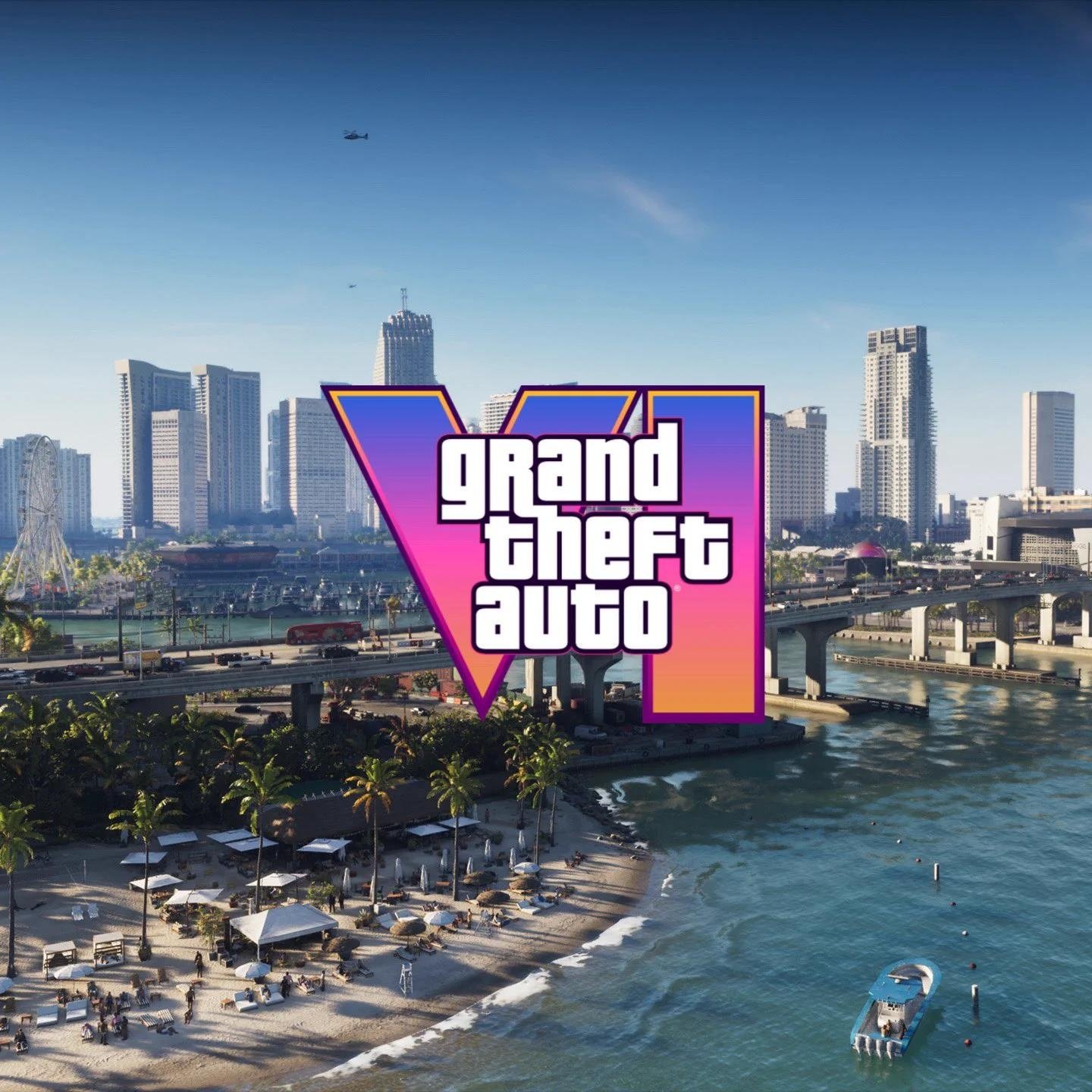
The coast seen from a very expensive height
After the prison, the water looks almost indecently inviting. A boat viewed from overhead cuts a legible path through the blue. Buildings rise neatly against the sky. Even the lanes of the distant bridges seem unusually considerate about where the viewer ought to look. What joins these images is an ease of movement available to the camera. It can leave a boat for a tower, get out over the wetlands and make the beach in time to see a crowd. Nobody on the ground has that itinerary. The pleasure comes partly from forgetting the vehicles, money and time an ordinary trip between such places would consume. Coming after a woman who cannot leave a room at will, the view has an edge that a travel advertisement would have good reason to sand off.
At the beach, that smooth movement runs into a problem of abundance. The immediate temptation is to pick someone out of the crowd. A body turned toward the water or a figure walking past a towel can hold the eye long enough to lose track of what everyone else was doing. On a second viewing, another corner becomes the center of an equally plausible little scene. This is a peculiarly generous use of extras. A crowd usually helps tell us where an important person is going, by opening in front of them or turning to watch. Here we have arrived between appointments with the protagonist. For a few seconds, someone who would normally be walking behind her gets an afternoon of their own.
That freedom to choose a subject is worth remembering once the social posts begin. A beachgoer who appears small in this composition could fill a phone screen in the next one. In the wide shot, the person can retain a kind of anonymity in full sunlight. In a post, one movement might become the thing thousands of strangers recognize them for. The number of people present has barely anything to do with the size of the audience a person ends up facing. Vice City’s shore gives that thought an appealing physical form. Almost everyone can see across the beach. Very few people can know who, at that moment, is looking specifically at them.
A rooftop pose finds its public
High on a rooftop, a woman turns toward the lens beside a pool. The skyline is handsome, but she has a better sense of timing than the buildings do. Her movement catches the eye and gives the shot a center in a fraction of a second. Up to this point it has been easy to imagine that the trailer’s camera can visit Vice City undetected. She makes that conceit difficult to sustain. Someone in front of the camera appears perfectly comfortable with its attention. Her pleasure in the encounter, whether we take it for play or self-presentation, is part of what makes the image attractive. A reading of GTA VI in which every lens merely steals something from its subject would have trouble accounting for that smile.
What the edge of a pool buys
The location does some of the work of posing. The pool edge makes a clean line against the city, and the open air leaves room around the figure. Down on the sand, a stranger can wander through the background and become more interesting by accident. On the roof, the person nearest the lens has a reasonably secure claim on our attention. It is possible to read that difference in class terms without knowing anything about the woman’s bank account. Somebody paid to build a place where a busy city can look like a private backdrop. Somebody else keeps it looking that way. The shot lets a visitor borrow the effect in the time it takes to turn around.
The transition to the social feed is persuasive because we have already enjoyed an image built on its terms. A dramatic background, an immediately readable gesture, a subject who knows where to look: very little needs to change for the rooftop moment to feel at home among the posts. What the feed adds is a visible route to other people. Instead of guessing who a pose is for, we see images packaged for an audience beyond the boat or pavement where someone recorded them. The rooftop remains an especially good image to remember during the rougher clips that follow. Having a say in the moment when a picture is made is a luxury too, and it is distributed as unevenly as access to a pool above the skyline.
The few seconds a stranger gets to be famous
The early posts move from a boat party to an alligator by a swimming pool and a woman dancing on a car roof. Each is easy to recount to someone who missed it. One noun and one verb will usually do. No viewer has to learn who owns the car, what occasion brought the boat party together, or how long the animal has been somebody’s problem. This economical storytelling is a genuine accomplishment of the people who make such clips, both the fictional residents pointing phones and the real artists inventing their footage. The observations feel local because somebody was standing in just the right place. Their appeal travels because the next viewer needs so little of that local knowledge to enjoy them.
The car roof changes the social arrangement of a street. Ordinarily the roof is wasted space from a spectator’s point of view. Raise a dancer onto it and even people a few cars back have a sightline. There are suddenly two audiences, one distributed along the road and another assembled afterward by the post. They experience different events. A driver behind the car might be delighted for ten seconds and profoundly irritated after five minutes. Online, those ten seconds can be the whole occasion. The trailer catches the entertaining proposition without assigning us any of its inconvenience. That bargain helps explain why spectators at a distance so often sound more enthusiastic about public disorder than the people hoping to get home through it.
The alligator at the pool offers an even sharper division of interests. Someone near that water has a practical problem that will continue after the best moment of the recording. Someone holding a phone has found material. Both can be the same person, switching priorities for a few seconds before attending to the animal again. That possibility makes the joke more affectionate than a simple sneer at people who film everything. Many viewers would want a record too, if only because nobody at work would believe the story on Monday. The sting comes from the edit. We get to take the improbable story with us. Getting a very large reptile away from the swimming pool remains a local responsibility.
The alligator at the shop door
At the convenience store the species makes a second appearance, this time before a security camera. A recurring animal is a fine cheap joke, especially when the second venue is even less suitable than the first. The change of equipment earns the repetition. By the pool, the existence of the clip implies a person who thought the animal worth documenting. At the shop, the recording would have been made if the next visitor had been a tired customer coming in for milk. The equipment carries a standing instruction about a particular piece of space. An alligator temporarily satisfies that instruction in the most extravagant way imaginable. Its indifference to retail etiquette finds an excellent partner in the camera’s indifference to wildlife.
What enters the evidence
A shop entrance is already an unusually busy line in the world. Step over it and a passerby becomes a customer, a delivery driver arrives at work, or an employee finally gets to go home. Security footage preserves the crossing while leaving most of those changes of status for somebody else to interpret later. That division of labor is funny with an alligator because the label feels like the only important thing about the visitor. Imagine the very same image on an ordinary Tuesday. A person could hesitate at the door because they have forgotten a wallet or because they dread seeing whoever works inside. The footage would show that hesitation with exquisite impartiality and provide almost no help with the question of why.
For a game that begins its pitch by asking Lucia to explain herself, this is quite a consequential limitation. A camera trained on a threshold can establish that she entered. It might show who came through beside her and what they carried. The more successfully it answers such questions, the easier it becomes to mistake the record for an account of her intentions. The alligator gives us a chance to enjoy the absurd version of that error before the montage brings human suspects into view. We laugh because a store camera has accidentally acquired the instincts of a wildlife documentarian. With an arrested person on the screen, the same confidence in a single picture will feel much less innocent.
A raid at the speed of a joke
The cut to body-camera footage changes what it feels like to move. In the shop, the fixed angle meant the audience could wait for something to enter a known space. During the raid, the person carrying the camera takes that space along with them. A doorway fills the image because somebody is approaching it. A turn of the torso alters what everyone watching can know. There is an intimacy to this arrangement that can be mistaken for understanding. We are close enough to feel the urgency in a movement while remaining spectacularly ill-equipped to judge the circumstances that made anyone move in the first place. A few seconds from inside the group can feel more persuasive than a minute spent hearing conflicting accounts afterward.
Placement makes the raid especially uncomfortable. The trailer has taught us a brisk, receptive rhythm: spot the unusual element, enjoy recognizing it, get ready for another. A change of camera gives only the smallest warning that the moral conditions of looking have changed. The people on the receiving end of the raid have little reason to share the viewer’s appetite for a dramatic entrance. Yet they occupy the place in the sequence where another novelty is due. It takes a conscious effort to linger on them, and lingering costs something quite literal. The music is still moving and the next image has already arrived. Pausing a trailer is easy. Recognizing which of fifty fleeting moments deserves the pause is harder.
The shot also borrows a visual pleasure that Grand Theft Auto players know well. There is excitement in moving through a doorway without knowing what lies beyond it. In a game, a player can have a stake in that uncertainty because the next action might depend on what comes into view. Here the viewer gets the charge of entry while someone else controls every footstep. That separation sheds light on the pleasures offered elsewhere in the montage. There has been very little danger in watching other people take risks. The raid briefly allows us to feel risk from the inside, with the peculiar protection of knowing that even a sudden turn of the head is somebody else’s responsibility.
The evening news takes possession of the street
An overturned car seen from above makes a remarkably tidy news picture. The disaster has edges. The vehicles around it give the eye points of reference. Put the broadcaster’s graphics over the image and an unfamiliar intersection becomes an event viewers can discuss while eating dinner. An earlier aerial view made coastal water and pleasure boats look composed. Here a comparable distance makes an accident legible. The broadcaster has a good reason to seek that height. A driver down on the asphalt might see a wall of traffic and have no idea what caused it. The aerial view is genuinely informative. The uncomfortable part is how easily the satisfaction of finally seeing the obstruction can crowd out concern about the person who was inside the car.
Then there is the mugshot. Few images in the trailer are so aggressively economical. A whole person can be introduced in the space reserved for a head, with a graphic to suggest how the face ought to be read. Put that face back into the beach crowd and one might invent almost any life for its owner. On the news, the range of stories an audience is likely to imagine contracts immediately. We saw a version of this with Lucia’s clothing at the desk. She got to complicate the impression by saying a few words. A person whose photograph appears while a broadcaster tells the story has to compete for even that small measure of influence over their own introduction.
There is a telling shift of scale, too, when the montage moves between riders in the street and aerial news imagery of riders occupying an intersection. Seen nearer their own level, riders can be distinguished by posture, balance and individual decisions about speed. Pulled together in the distant view, their numbers become the event. Traffic and police acquire greater weight in the composition, and it is easy to imagine why a station would choose that angle. Each picture answers a question a resident might reasonably have. What did it feel like to be there? Could anyone get through the intersection? The broadcast’s power lies partly in being able to decide which question a city spends the evening asking.
The one audience Lucia chooses
Late in the first trailer, Lucia looks behind her in a car. Cash and a bandana give us plenty to work with if we want to turn the glimpse into an incident report. Where the money came from, precisely what happened earlier and what she expects to see behind the vehicle all remain open. Yet by now the image belongs to a person we remember from the opening interview. We are likely to extend her a courtesy we scarcely considered extending to the face in the news graphic. We assume there is more to the story. That small and rather embarrassing disparity is one of the advantages of putting the montage between two meetings with the same protagonist. Affection for a character exposes how little evidence it took to pass judgment on a stranger.
A word that needs an answer
In a dim room, with Jason close enough that she scarcely needs to project her voice, Lucia asks, “Trust?” He answers with the same word. On paper the exchange looks almost absurdly spare. On screen the repetition accomplishes something a more eloquent declaration could easily spoil. He has to decide whether he will take up the particular word she offers him. A camera could preserve both faces for years and still have no means of determining whether he means it or whether, at the moment she asks, she believes that he does. The audience can have an opinion, of course. Having an opinion is inexpensive. Making plans that depend on the sincerity of another person’s answer costs considerably more.
The bandanas around the robbery scenes give that exchange an unexpectedly concrete counterpart. To a witness, covering a face removes information. To an accomplice who knows the face already, the same piece of fabric can say quite a lot. It can mean that the other person is ready or that a moment they have discussed in private is finally happening. One gesture sends two messages, and proximity alone will never tell a spectator which one matters most. A security camera could get a perfectly clear picture of both people crossing a shop threshold and miss the most consequential thing that has passed between them. We have been invited to hear it in a quiet room, where it takes the form of a single repeated syllable.
Jason gets a morning before he gets a headline
The second trailer offers something that the first, with its hurry to introduce an entire state, could scarcely afford. It lets Jason put in a little time before he sees Lucia. We find him doing work on a roof. Someone below can talk to him. This is the second important rooftop in these trailers, and practically everything about its use has changed. The surface beneath the posing woman made an elegant platform for looking out over the city. This one requires attention in its own right. For a few moments a roof in Leonida is simply a thing that someone has to keep in repair. Remember the people absent from that lovely poolside composition and Jason’s introduction begins to look like an answer to an earlier picture.
A day with a destination rearranges the emotional weight of the errands that come before it. Once it becomes clear that Jason is going to collect Lucia from prison, his earlier movements acquire the familiar texture of time spent waiting for an appointment that matters. An outsider seeing him at work would have no particular reason to guess what else was on his mind. That ordinariness is generous to the character. Put a man in a promotional image beside a car, a woman and a stack of money, and the temptation is to read his whole life as preparation for a score. Give him a roof that needs fixing on the day someone he cares about comes home, and the person has claims on his attention that can coexist untidily.
Lucia’s release also changes the meaning of the prison exterior. The first trailer used wire to establish the boundary that defined the terms of her interview. A person waiting outside makes the same boundary measurable in a different unit. There is a last stretch of time when Jason can get as close as the institution allows and still cannot take her home. Their reunion gives that wait an endpoint, and the time the trailer has spent reaching it gives the encounter an ordinary human scale. Many viewers will have waited outside an arrivals gate, a hospital or some other door that opens on someone else’s schedule. Very few will have lived the headline-ready version of this couple’s life. A wait is enough to bring them within reach.
Conclusion · What happens after the camera has its picture
The alligator clip ends at exactly the moment it has paid its debt to an audience. We wanted to see the unlikely thing, and there it is, inside the store. Imagine letting the recording run for another ten minutes. The animal might stop moving. A worker might have to keep customers back, make a call, repeat the address and wait. Each additional minute would make the scene less efficient as comedy and more revealing as a picture of somebody’s working day. In its account of Jason going to meet Lucia, the second trailer spends some of those hypothetical minutes. It follows a person through the stretch of life a good clip would discard. The reward is that a meeting at a gate can move us after a succession of louder images has barely left a mark.
That difference in duration explains why Vice City feels most fully inhabited at moments when the pictures disagree. A dancer has made excellent use of a car roof. A person with somewhere to be might remember the resulting delay with perfect bitterness. A station looking down from above could give an accurate account of the traffic and never discover what was good about being there. An audience that has seen all three kinds of picture can entertain all three accounts, provided it remembers what fell outside each frame. The accomplishment of GTA VI’s trailers is to give that idea a local address and a sense of humor. A shop doorway, a prison gate and the edge of a swimming pool each divide the world differently depending on who is watching from which side.
What stays with me is the tiny gap between Lucia’s question and Jason’s answer. Elsewhere there is almost always another image ready to relieve us of the burden of waiting. Here a delay carries information that no graphic could print at the bottom of a screen. She has done what she can by asking. For an instant the next part of her life is somebody else’s to decide. Vice City can put a camera over the door they will walk through, send a helicopter after their car and find space on the evening news for their faces. Back in that room, with the question still hanging between them, even a city so lavishly equipped to watch has to wait along with her